
Patient education · Definition
What is
Integrative physiotherapy is evidence-based physiotherapy that treats the whole person, not just the injured part. At GC Integrative it means uniting Western clinical science — assessment, hands-on care, graded exercise and rehabilitation — with Eastern-informed movement such as breath, balance and slow, body-aware practice, inside one physiotherapist-led clinical model.
Published · Last reviewed · Gary Chen, AHPRA-registered physiotherapist
Put simply, integrative physiotherapy asks two questions at once: what structure and function are affected, and how breath, regulation and lived experience are shaping the way you move. Both are answered through physiotherapy assessment and clinical reasoning, and both are delivered within AHPRA physiotherapy scope of practice. Eastern-informed techniques are evidence-informed adjuncts — never stand-alone treatments, and never a replacement for medical care.
The word integrative can be used loosely, so it is worth being precise. At GC Integrative Physiotherapy & Wellness the term does not mean adding alternative therapies alongside physiotherapy. It means one profession — physiotherapy — drawing on two complementary bodies of knowledge and translating both through the same clinical lens. Western science supplies the assessment, biomechanics, pain science, graded loading and outcome measurement. Eastern movement traditions contribute breath, rhythm, slow movement and body awareness. Neither is layered on top of the other; they are integrated into a single method led by Gary Chen, an AHPRA-registered physiotherapist.
What integrative physiotherapy is — and what it is not
Clarity about scope is part of doing this well. Integrative physiotherapy, as practised at GC Integrative, is:
- Physiotherapist-led care delivered by an AHPRA-registered practitioner within professional scope.
- Evidence-based and evidence-informed, combining conventional physiotherapy with movement practices that have a reasonable basis for supporting function.
- Whole-person: it considers the physical body and the way breath, tension and confidence affect how movement is experienced.
- Outcome-measured and individually assessed, with a clear plan you can follow.
Equally, integrative physiotherapy is not alternative or complementary medicine, it does not make cure, miracle or guaranteed-result claims, and it is not a replacement for a GP, medical specialist, psychologist, psychiatrist or emergency care. Eastern-informed techniques such as qigong-informed movement or breath-work are used as adjuncts within physiotherapy scope, never as stand-alone therapies. This discipline is what keeps the approach both credible and safe.
Two domains: Structure and Regulation
The clinical engine of integrative physiotherapy at GC Integrative is a framework called the GC Health Model, which looks at health through two domains that are always considered together.
Structure — the Western clinical lens
Structure is the physical, measurable body: movement, strength, mobility, load tolerance and tissue capacity. This is the familiar territory of physiotherapy — movement assessment, strength and mobility work, graded loading, gait and balance training, and functional tasks. It answers the question of what is happening in the body and how it is changing over time.
Regulation — the Eastern-informed lens
Regulation covers breath, body awareness and the easing of protective tension — the internal state that shapes how safe or threatened movement feels. It is delivered as an evidence-informed adjunct within physiotherapy scope, using breath coordination, body-awareness practice and slow, rhythmic movement. Regulation is clinical rather than mystical: it draws on interoception — the sense of your own internal body state — which links awareness, pain perception, breath and confidence with movement.
Treating both domains together is the core idea. Two people with the same structural diagnosis can experience it very differently depending on breath, tension and confidence. Addressing only the structure can leave that second half of the picture unattended.
The clinical cycle
The Six-Stage Cycle
Integrative care at GC Integrative moves through a six-stage clinical cycle. Each stage is a focus of care, not a fixed timeline — your assessment sets the pace and the entry point.
Release
Easing protective tension through gentle hands-on care, mobility and education, so movement can begin to feel safer.
Regulate
Settling breath and pacing through body-awareness practice, within physiotherapy care.
Pre-Pattern
Low-threat movement rehearsal that builds confidence before heavier strengthening or daily-life challenge.
Balance
Building steadiness through supported balance, weight-shift, gait and strength work to improve falls confidence.
Integrate
Connecting movement gains into walking, standing, lifting, daily tasks and real home routines.
Empower
Handing back a home plan, a flare-up plan and a review pathway to support self-management and independence.
Evidence-informed adjuncts within physiotherapy scope
The Eastern-informed side of integrative physiotherapy is delivered through the Physio-Qi Method — a physiotherapist-designed, qigong-informed therapeutic movement approach offered at seated, supported and standing levels. Where clinically appropriate, it can add light, physiotherapist-graded resistance, so the same practice can support strength and bone-loading alongside balance and breath. Suitability and load are individually assessed; the method is not suitable for everyone and no outcome is guaranteed.
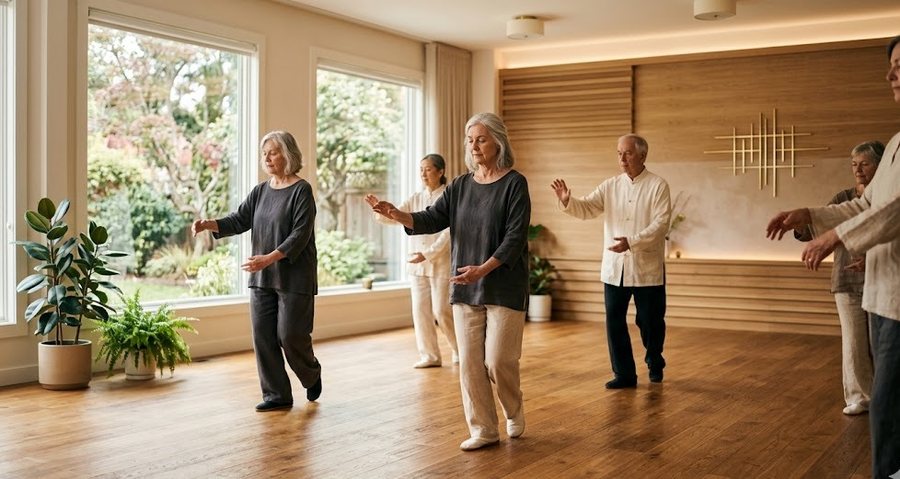
Adjuncts are always translated through clinical reasoning. Breath-work is used to support pacing and down-regulation, not to treat anxiety or psychiatric conditions. Slow, body-aware movement is used to rebuild confidence and coordination, not to claim that it “releases” stored emotion or trauma. Where needs fall outside physiotherapy scope, the right course of action is a referral to the appropriate professional — and that boundary is treated as part of good care, not an exception to it.
AHPRA scope, safety and honesty
Integrative physiotherapy only earns trust when its limits are stated plainly. All care is provided by an AHPRA-registered physiotherapist within professional scope. It supports, and does not replace, your GP or specialist care. If symptoms are severe, new or worsening, the right step is to contact your GP or call 000. Results vary between individuals, and no program can promise a specific outcome. These are not disclaimers bolted on at the end; they are how evidence-informed, whole-person physiotherapy is meant to be practised.
Who integrative physiotherapy may suit
Integrative physiotherapy may be a good fit for people who want their care to consider the whole picture rather than a single body part. It is most commonly applied to:
- Persistent pain and movement rehabilitation, where fear of movement and flare-ups are part of the story.
- Balance and falls confidence for older adults and the families who support them.
- Reduced mobility, stiffness or deconditioning after illness, inactivity or time.
- Stress-related physical tension, guarding and shallow breath patterns that affect movement.
- Older-adult function and independence at home, in retirement villages and in aged-care settings.
Because delivery is flexible, care can come to you — in your home, in aged-care facilities and retirement villages, and in community settings across the North Gold Coast. Not sure whether it fits your situation? The Find My Pathway guide points you to the most relevant next step.
What a first appointment involves
A first integrative physiotherapy appointment is, first and foremost, a thorough assessment. In practice it usually includes:
- Your story and goals. What has changed, what you are finding hard, and what a good outcome would look like for you.
- A safety screen. A red-flag check to make sure physiotherapy is appropriate and to identify anything that needs a GP or specialist first.
- A physical assessment. Movement, strength, mobility, balance and gait, alongside breath and body-awareness observations.
- A shared plan. A clear explanation of what was found and a personalised plan that may combine hands-on care, graded exercise and evidence-informed movement.
- A home program. Simple, practical things to work on between sessions, with reporting to your GP or care team where appropriate and with your consent.
If you would like to experience how the stages connect before booking, the interactive care pathway walks through the journey from first contact to self-management.
Common questions
Is integrative physiotherapy evidence-based and AHPRA-recognised?
How is integrative physiotherapy different from a standard physiotherapy clinic?
Is integrative physiotherapy the same as alternative or complementary medicine?
Who is integrative physiotherapy suitable for?
What happens in a first integrative physiotherapy appointment?
Sources
- World Health Organization. Rehabilitation — fact sheet. Accessed 14 September 2026.
- World Health Organization. Ageing and health — fact sheet. Accessed 14 September 2026.
- Australian Physiotherapy Association. australian.physio. Accessed 14 September 2026.
- Ahpra. Registers of practitioners. Accessed 14 September 2026.
External links open in a new tab. Last checked 14 September 2026.

About the author
Gary Chen
Gary Chen is an AHPRA-registered physiotherapist (Physiotherapy Board of Australia) and the founder of GC Integrative Physiotherapy & Wellness on the North Gold Coast. He developed the GC Health Model and the Physio-Qi Method to unite evidence-based Western clinical science with Eastern movement heritage from Taiwan, delivered as evidence-informed adjuncts within physiotherapy scope.
Read Gary’s full profile →See where you fit in the model.
Whether it is for you or someone you care for, we will point you to the right pathway and a scope-safe first step.